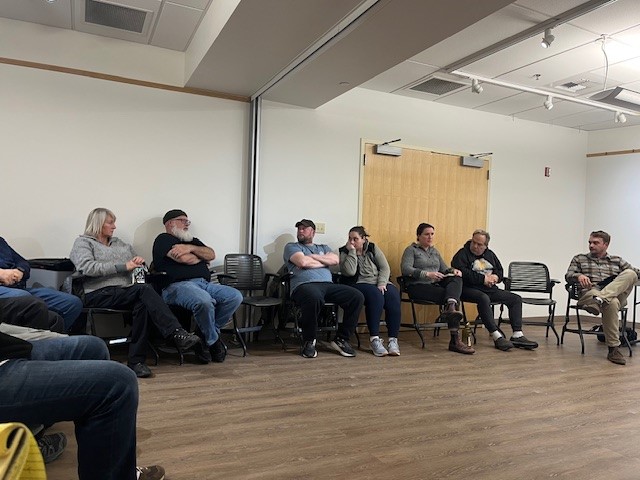
Fishermen filled a classroom at the Nolan Center on Feb. 3, as part of a roundtable invitation from Wrangell officials to see how they can be more supportive of the local industry. Some held complimentary beers from the city — part of what borough officials called a casual kickoff to more engagement with the fleet.
Borough Manager Mason Villarma acknowledged those conversations haven’t happened often.
“We haven’t done a whole lot of engagement with you guys throughout the year,” he said. “We wanted to kick it off this year with a discussion on what we can do as a city to better support the industry.”
Villarma started with an informal presentation on city projects, from harbor improvements to discussions about managing sea otter populations.
But as the presentation wrapped up, fishermen had concerns of their own, which included costs, infrastructure and the future of the working waterfront.
Fisherman Antonio Silva raised questions about the city’s new 40-year lease agreement with American Cruise Lines.
The small-scale cruise company recently signed a long-term lease with the city. Its website says it uses locally sourced ingredients.
Silva said if the city is committing to work closely with the cruise company, local seafood should be part of that partnership.
Eroded trust with the chance to rebuild
He pointed to a previous attempt by a local oyster business to work with the company.
“I know that there was a negative interaction with American Cruise Lines, and Brian there with his oyster business, trying to do something exactly like this,” Silva said. “He felt he got burned, and it kind of soured his taste with American Cruise Lines.”
Silva said a clearer commitment to local sourcing could help rebuild trust.
“It’d be a huge hit to a lot of the townspeople”
The conversation then shifted to infrastructure — specifically, the city-owned cold storage facility.
Villarma said the city is exploring the possibility of selling the facility to a commercial processor, noting that much of the space isn’t being used by local fishermen.
But several in the room pushed back, saying the freezer is critical, especially for those who directly market their catch.
“It’d be a huge hit to a lot of the townspeople in town that use it to store moose or other product,” Silva said. “I know that there’s even small businesses that aren’t affiliated with fishing who use it. I mean, you see all three processors use that space.”
Fisherman Brenda Schwartz-Yeager said access to the freezer allows smaller operators to stay competitive.
“Some of the fishermen in this room, we are utilizing that facility, and probably couldn’t do a lot of what we do without that,” she said. “I really appreciate having it.”
She said if the city does move forward with a sale, fishermen hope future ownership would still prioritize local access.
Rising operating costs
Beyond infrastructure, fishermen also raised concerns about rising operating costs, including shipping and fuel.
Silva said direct-market sellers often don’t ship enough volume to qualify for lower freight rates.
He said the price break typically starts around 3,000 to 4,000 pounds.
“They’re gouging our industry”
And fuel prices are another pressure point.
Fisherman Winston Davies said commercial fishermen are paying more at the dock than drivers on the road — even without road taxes.
“They’re gouging our industry of commercial fishermen,” he said. “It never used to be like that.”
City officials offered a few potential solutions.
Adding local seafood suppliers to city’s websites
Economic Development Director Kate Thomas suggested adding local seafood suppliers to city tourism and harbor websites to boost visibility.
Villarma also floated a possible pilot program during tourist season, allowing fishermen to sell directly at city events.
As for the freezer, he said more discussion is needed before any decision is made.
Potential equity with fishermen
Villarma said a potential sale could include joint equity with fishermen.
For many in the room, the discussion wasn’t about opposing growth — but about making sure fishing remains part of it.
As tourism expands and new partnerships take shape, fishermen said they want the working waterfront to remain central to Wrangell’s future.