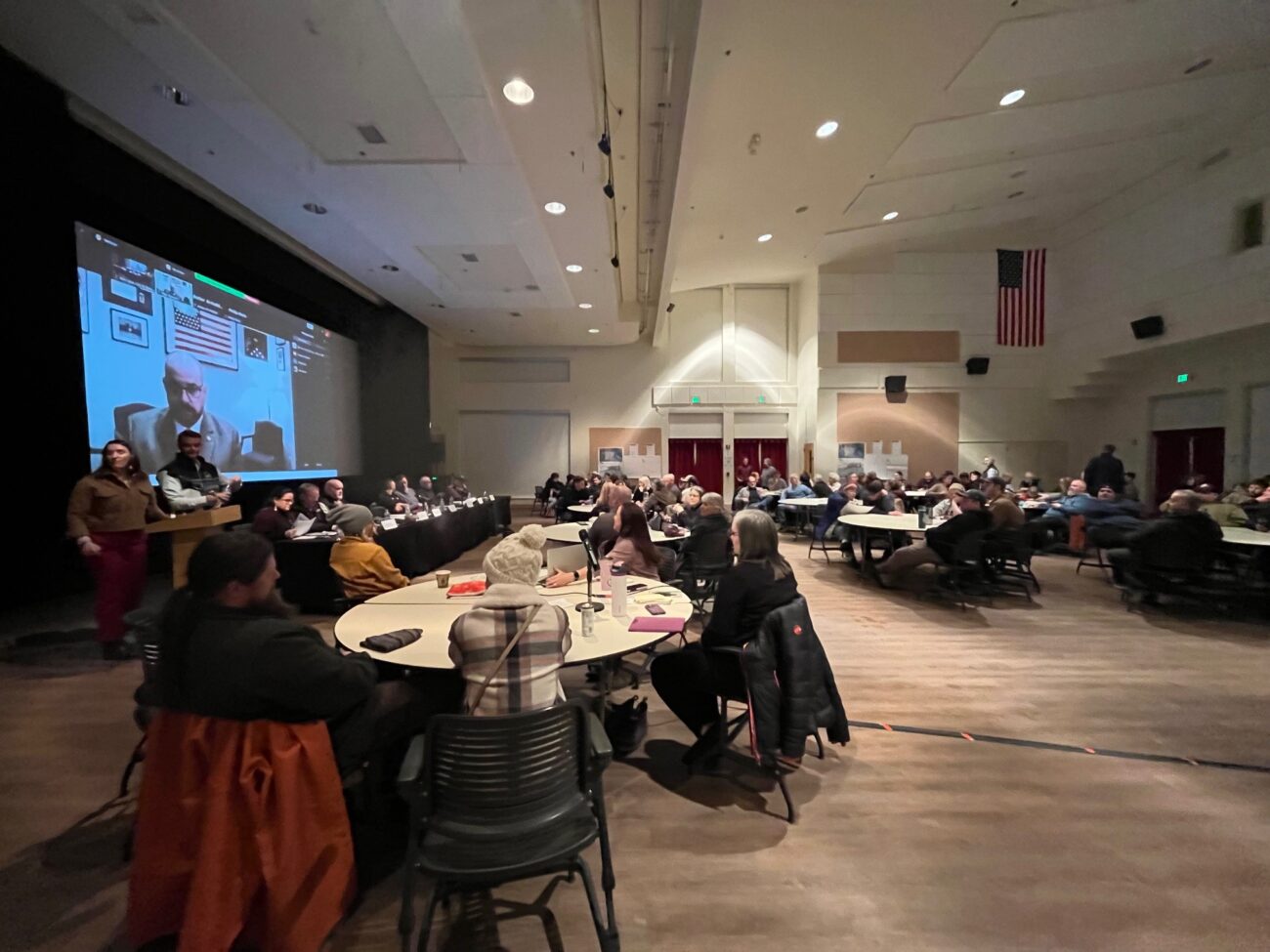
More than 100 community members fill the Nolan Center’s (Wrangell’s civic center’s) main gathering room, chattering before Thursday’s town hall meeting.
Normally, the crowd would be unusual for a borough-led meeting, but then again, the city’s making way for significant changes involving major development and new opportunities. Some key industry leaders flew in from other states to speak about their proposed developments for the Southeast island. Officials are applying for a $50 million EDA – or federal economic disaster grant for the landslide in 2023 that killed six people.
Key potential projects include deepwater port redevelopment, waterfront expansion and a reservoir flume upgrade. The total investment is over $53 million. The borough’s requesting $42 million and it will contribute a little over $11 million coming from the borough as a 20% matching entity to the grant.
For four years, the city’s been trying to figure out what to do with the deepwater port six miles out of town, which stopped being used after a sawmill closed.
The city now wants to collaborate with Alaska Marine Lines, JAG Marine Group and Greensparc’s data center at the port, aiming to create 150 jobs.
Industry at the deepwater port
JAG Marine is a maritime fabrication and vessel repair firm that normally works with larger maritime craft. They would build a new shipyard, which could alleviate backlogs in their Ketchikan and Seward locations. Greensparc would install a small-scale data center, aiming to use 3.5 megawatts of power, potentially reducing utility rates. And Alaska Marine Lines is the region’s main barge company, which is interested in relocating the barge ramp to the area. The city decommissioned the ramp last year due to deteriorating infrastructure.
Community members expressed concerns about competition with local shipwright businesses.
But JAG insists there’s no competition because they only work on large ships – like U.S. government vessels, ferries and tug and barges.
“It’s been underwhelming and underperforming”
Residents also voiced environmental concerns with the data center, which are known to consume a lot of water to cool the facilities.
A data center this size uses at least 70,000 gallons of water each day, which is comparable to more than 200 households.
But CEO Sam Enoka said the data center would use a closed-loop water cooling system, essentially recycling the same water.
A Cordova resident who happened to be in town for work, was here and said to be cautious about partnering with the data center. Kasey Kinsman said the Greensparc data center in his own community hasn’t gone well.
“From a community member, it’s been underwhelming and underperforming,” he said. “It’s been years, and we have not seen this output that was promised with you (Enoka) and the deal you made.”
He said the community hasn’t seen any savings in energy rates, like the company mentioned, and he wanted to hear about the lessons the company learned.
Local computing needs didn’t materialize in Cordova
Enoka said the pilot project in Cordova was intended to serve local computing needs, but that didn’t materialize. He said AI grew rapidly, resulting in a greater demand for energy. Additionally, the data center is not on the road system, presenting another challenge. He said the company is still learning in Cordova and they’re building from that.
Parks and Recreation director Lucy Robinson questioned how the companies will encourage their staff to be part of the community. She said community involvement, like volunteering, is how the community survives.
“The same 10 people in town do the same thing over and over and over again,” she said.
In response, JAG Marine senior project manager Tim Jagielski II talked about their partnership with Seward, where he said their employees are involved in the community. On top of that, the company has a 10% give back program to the communities they’re in.
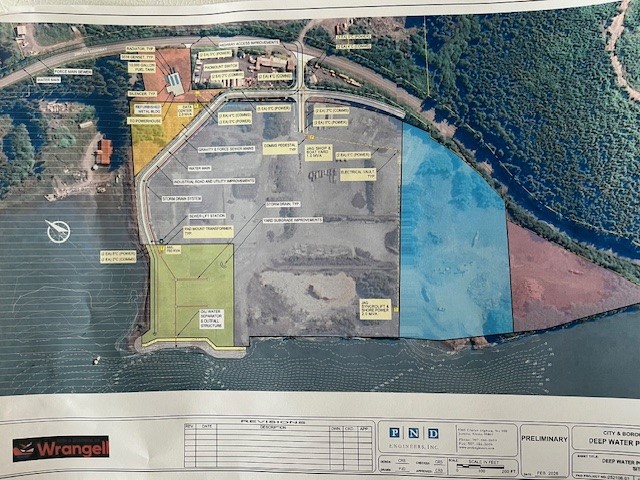
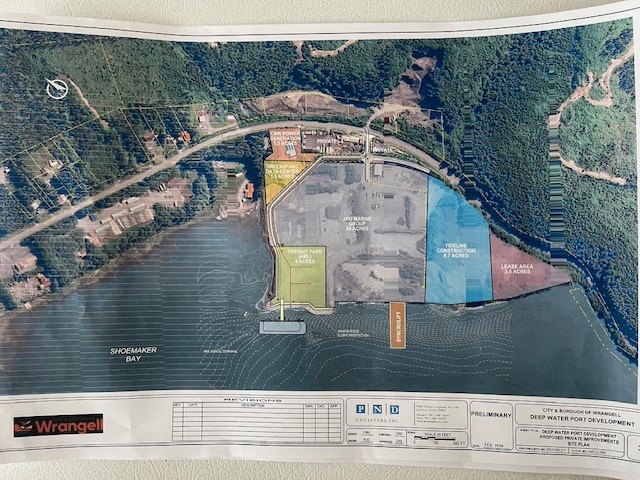
Preliminary borough plans for the deep water port development six-miles out of town as of Feb. 2026. (Colette Czarnecki/KSTK)
“We want to get out of the cycle of plan from 2009 and plan and plan and plan”
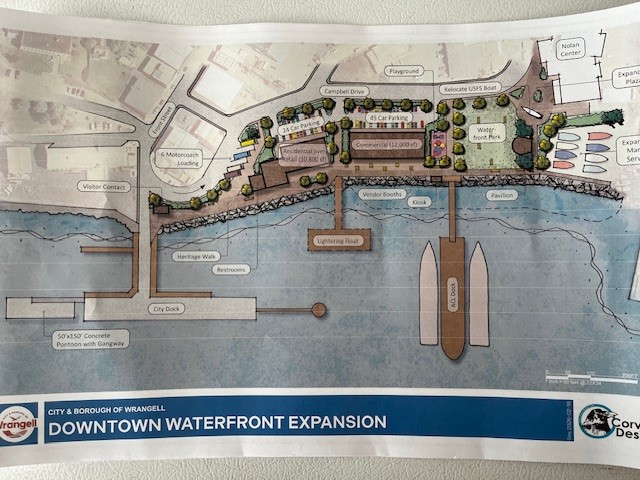
Another big-ticket item the city is proposing is developing more of the waterfront, which they’ve considered for 20 years. City officials say it would enhance cruise ship docking, community facilities and green space. Additionally, a flume project would reduce water loss by 15%. This flume transports water for the drinking water reservoir and is in really bad shape. The city wants to replace it with a concrete flume.
Borough Manager Mason Villarma said it’s time to move forward with these plans.
“We want to get out of the cycle of plan from 2009 and plan and plan and plan and then we never do anything,” he said. “So we’re trying to act on the plan.”
One example is filling out the footprint of the downtown waterfront, which is expected to happen this summer. In partnership, American Cruise Lines will have a docking facility there for their small-scale cruise ships that sail less than 200 people. The company’s goal is to have that complete by May 2027.
Wrangell officials say the city will never resemble Juneau or Ketchikan’s tourism
Villarma said there’s no way the city will ever be a Juneau or Ketchikan, in terms of how many visitors cruise ships get here.
To back that up, presenters from Rain Coast Data and Cruise Line Agencies of Alaska compared Wrangell tourism with significantly bigger cities like Juneau. Juneau saw roughly 1.7 million tourists and Sitka was about a third of that at 585,000 at last year. Wrangell, however, had more than 40,000. The city expects around 68,000 passengers this year.
Wrangellite Keith Appleman said it’s not accurate to compare Wrangell with Juneau or other cities. Instead, it’s necessary to consider the growth or decline by years.
“When you go from 19,000 to 30,000, and possibly it sounds like maybe doubling next year, close to it, I think that percentage of increase is more important than looking at Wrangell compared to Sitka or Juneau or Ketchikan,” he said.
The city is also exploring a land exchange with the state’s Trust Land Office to secure 266 acres for development in exchange for a 27-acre parcel adjacent to the golf course. The Trust Land Office plans to subdivide the 266 acres and sell them as residential lots. Wrangell officials say this could bring in more housing opportunities.
Wrangell’s assembly will consider approving the EDA Disaster Supplemental Grant application Tuesday (Feb. 24), which could allow these proposed projects to happen.