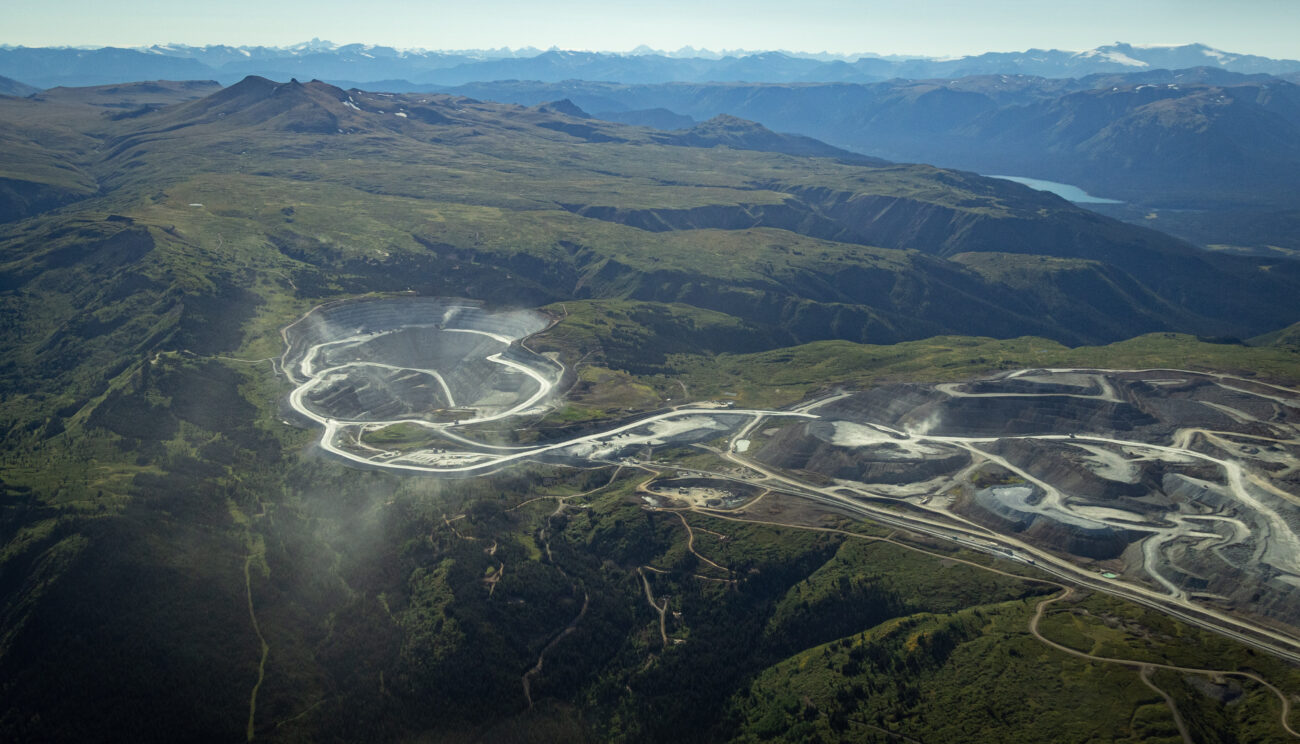
River, a major tributary of the salmon-bearing Stikine River. An underground mine expansion is
proposed under the open pit and is on the Premier’s list of projects to “fast-track.” Photo by
Colin Arisman
British Columbia sent a letter in late January to Alaska and Washington state Tribes informing them that the Province is proposing to amend the Environmental Assessment Act, excluding U.S. Tribes from government consultations related to environmental projects. If the proposal passes through the legislative process in Victoria, U.S.-based Tribes say the Province would essentially lock them into a lower tier of participation, which would negatively affect their communities when considering mines and infrastructure near the border.
Under Canada’s Constitution (Section 35), governments have a duty to consult Indigenous Nations if projects affect their Aboriginal rights, according to the case R v Desautel. But Alaska Tribes and the Lummi Nation in Washington say the Province hasn’t meaningfully consulted them about B.C.’s mining projects, just notified. So they have taken British Columbia to court. The tribes argue that instead of letting the court decide on those cases, British Columbia is trying to change the law. And if the law changes, then the tribes’ court cases would be irrelevant.
Guy Archibald, executive director of Southeast Indigenous Transboundary Commission, which advocates for 13 Tribes, said limiting input from U.S. Tribes put a line on the map that cuts the transboundary watershed in half.
He said, “Nothing in nature respects that line on the map.”
Archibald said if a mine upstream leaks heavy metals, tailings, or acid drainage, the pollution doesn’t stop at the border. He said this could affect salmon populations that many Southeast Alaska communities depend on.
Tribal duty to steward the land
He said one example of environmental hazards is the Eskay Creek Mine in the Unuk Watershed. The first one closed in 2015, and the hooligan population dramatically decreased while that mine was in operation.
The business is planning on opening a second Eskay Creek Mine in 2027. Archibald said he was looking at the air quality permit, and B.C. could allow varying levels of lead, including 62 mg of lead a day.
“How can you literally rain lead into a watershed and say it’s not going to have any effect,” he said. “There is no safe, biologically safe level of lead.”
He said excluding downstream tribes violates a tribal duty to steward the land and preserve the environment that has sustained them for future generations.
“It kind of rips the heart out of cultural continuity,” Archibald said.
Gabriel Cantu, a lawyer who represents the Lummi Nation, located northeast of Bellingham, Washington, said historical documents and archaeological sites confirm the Lummi has existed across the current Canadian border west of the Boundary Bay.
“Canada, the Crown, B.C.’s failure to meet that deep consultation duty does not meet the honor of the Crown,” he said. “Honor is very important.”
Although mining isn’t an issue for the Nation, Cantu said they’re fighting to be consulted about several infrastructure projects – one would replace an underwater tunnel. He said these projects could impact salmon in the nearby Fraser River. Although the Tribe’s been notified, they haven’t been consulted by British Columbia.
“What we received from B.C. is generally a notification that they have already begun to do things that infringe upon limitations, assertive rights within the Fraser Delta, both on land and water,” he said. “Notification is as far as they’ve gotten.”
He said Canada has a legal duty to meet the highest level of consultation and recognition for Aboriginal rights in Tribes that may cross boundaries, like Lummi.
“disrespect for the rule of law”
He said amending the Environmental Assessment Act is just another step in disqualifying U.S. Tribes from engaging in deep and meaningful consultations.
“This is, in effect, B.C.’s disrespect for the rule of law, Canadian law, their own law,” Cantu said.
In an email to KSTK, the Province’s Environmental Assessment Office said they take their obligations to consult with Indigenous Tribes very seriously. And that includes in the U.S., if they have a credible assertion of Aboriginal rights from the Supreme Court’s ruling.
They said they are developing a consultation policy that will clarify how the Province consults with U.S. Tribes that have asserted rights in B.C.
If B.C.’s amendment to the Province’s Environmental Assessment Act is approved, it could become law by late 2027.