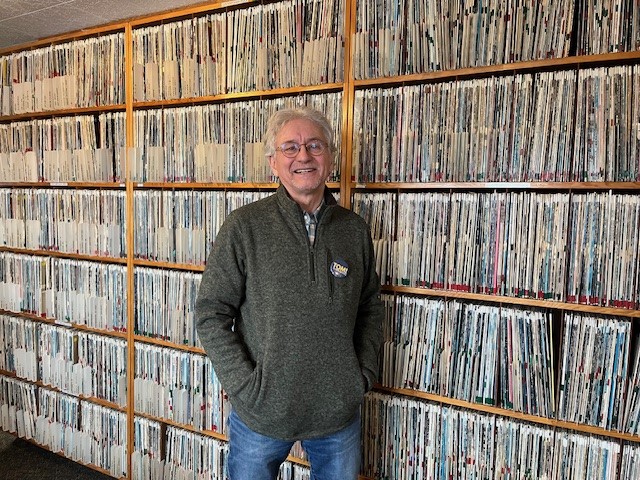
Former Alaska State Senator Tom Begich is one of 18 candidates running for governor in the Last Frontier. He’s a Democrat, and the uncle to Alaska Congressman Nick Begich III, who is a Republican. In mid-March, Tom Begich visited several Southeast communities, including Wrangell. In an interview with KSTK’s Colette Czarnecki, he said this isn’t the only time he’s going to visit town before the election.
Full Interview:
This conversation has been edited for clarity and brevity.
There’s something to having spent 30 years working in rural communities. On substance use prevention, violence prevention, suicide prevention, mental health issues and juvenile justice. These issues literally permeate our communities around the state. I’ve slept on gym floors in Western Alaska. I’ve even once been in a jail cell in Point Hope, because that was the only bed available. But you stay where you have to stay, and you get to know people.
Why are you running for governor?
I do deeply love my state. I was born here.
We really worked hard in the six years that I was in the Senate as minority leader to build those cross party relationships. Not just within my caucus, but also with the majorities and the minorities in both bodies. As time has gone by since I left, which was in 2022, I’ve really watched those relationships between the governor and the legislature deteriorate. I think that that is bad for Alaska.
I think my willingness to change the dialogue, to look at pushing for that strong, forward and fully funded education system, moving us away from a dependency on diesel fuel and moving toward alternatives in the state. It’s about actually finding ways to sustain the state as independently as we can in the long run. It’s important for us to maximize our resources in terms of the Permanent Fund. Ensuring that it not just survives, but thrives, because it produces 60% of Alaska’s income today. It means that we have to ensure that when we have multinational corporations coming into our state and taking our resources, we get our fair share of those resources.
Your nephew, Representative Nick Begich, is a Republican. How do you navigate campaigning the state where your family name cuts both ways politically?
I do my best to ensure that they understand I represent different values than he does.
Look, I grew up in a family where my brothers and sisters did not always agree. My mom raised us – single mom. Part of that upbringing was to be patient, listen to others perspectives and then move forward. Well, I don’t begrudge a different perspective.
What’s your specific plan to resolve the long running standoff of education in Juneau?
Do we have the money to fund a solid education system? We’re often told we don’t. What we actually do have is the resources there. We just do not collect them. There’s the internet fee that was tied to education for $35 million that literally was vetoed by the governor, and legislature did not override that veto, but if I’m governor, I’ll be signing that bill into law the day it comes on my desk.
I will sign into law the exception that has allowed Hilcorp not to pay corporate income tax on its oil properties. They’re the only oil company that does that because of a loophole in the law. That loophole should be closed so that we do not further risk losing corporate income tax and that we collect that $100 to $150 million. And finally, I have advocated for, and the Senate resources has now adopted, an approach that would reduce the oil and gas tax credits on the three largest oil fields on the North Slope – Prudhoe, Alpine and Kuparak. Those would generate, in my estimate, between $200 to $250 million.
We’re going to move on to the Alaska Marine Highway. Will you talk about your plan with that?
I believe it should be a separate authority that also has the capacity to bond.
Number two, ensuring the vessels that we produce and those vessels are interchangeable.
Third is to deal with the deferred maintenance that has been neglected for so long. I would do that with a general obligation bond.
But here’s the thing with the ferry service, you have to have known regular service. It is a system that serves life and health issues for everyday Alaskans, and it is the connector for all the pieces of Highway 7. It is a highway.
What’s your position on the Permanent Fund Dividend? How should the state balance the PFD against services?
There is nobody that I am aware of that is a serious candidate that thinks that the dividend can stay with the current statutory formula. I think you should rewrite the statute so that the check itself is tied to the volatility of the Permanent Fund itself. What I mean by that is, if the Permanent Fund is making money, then that check goes up from an initial amount that you started at. If it loses money, it goes down, and then in the end, you’re able to maintain a dividend that is an appropriate dividend that we can afford while providing public services.
Last question, you’re also a singer songwriter and a poet. How has that creative life shaped how you think about leadership and listening?
I try to write music or poetry that is reflective of the human condition and the ability to be empathetic, to listen, to feel what other people are thinking or what other people are struggling with, informs my music and my poetry. Being heard is exactly what a singer songwriter or poet must do, and being heard is a skill set that anyone in politics ought to have.
But when I finally realized these two things were not separate, but connected, it made me a better person and a whole person. And I think that that will make me a much better governor.