Alaska’s school funding formula creates an unusual dynamic for local governments. The money a borough contributes to its school district can actually reduce what the state gives.
Because of this uncomfortable catch, Wrangell’s borough assembly is weighing whether to give its school district an additional $150,000.
For the next fiscal year in 2027, Wrangell Public Schools has a base funding target of $4,116,973. If the borough pays over the allowable maximum of $1.9 million, the state contributes less to meet that target and the state will fine the borough. Essentially, it’s a balancing act, and the borough ends up filling in for the state.
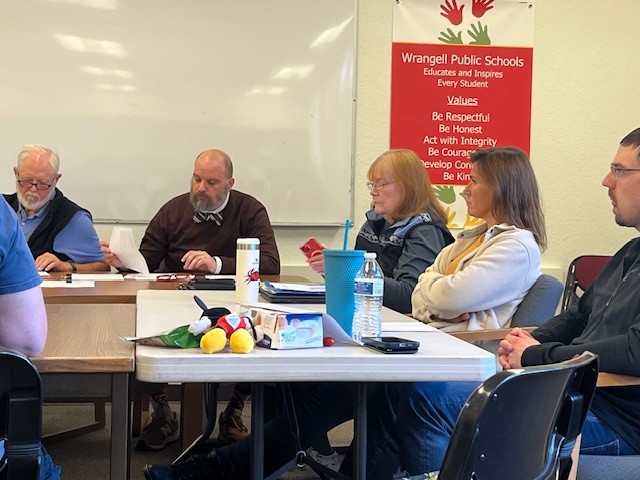
While some school districts in Alaska are facing teacher cuts and school consolidations, Wrangell is not in immediate crisis. But at an April 27 joint work session, the borough assembly and school board still faced a difficult question: how much should the borough contribute for the coming fiscal year?
Chief Financial Officer Kristy Andrew said the borough can give up to $949,000 above its required maximum contribution without triggering a reduction in state funding. Beyond that threshold, the state’s share shrinks.
“It’s the required local effort that the state offsets — any additional allowable contribution from the city is truly extra, and that’s really what helps us,” she said. “So you could give us up to $949,000 in additional revenue without any penalties from the state.”
Compared to a year ago, the finances are looking up. Last year, Andrew projected the district would end this fiscal year with just under $54,000 in reserves. The turnaround is largely thanks to a $700 per-student funding increase from the state last year, called the Base Student Allocation. Alaska lawmakers overrode Governor Mike Dunleavy’s veto to make it happen. Enrollment gains and careful spending also helped, she said.
One less intensive student means less state funding
Next fiscal year, the district is projecting 258 students enrolled, with six receiving intensive special education services — one fewer than this year. That reduction means $86,580 less state funding coming in.
“Everybody remember…the adopted budget had a fund balance at the end of this year of $53,907,” Wrangell Public Schools’ Superintendent Joshua Garrett said. “Right now, we’re expecting our June 30 fund balance to be over a million dollars. That’s good. That’s really good news. That’s outstanding.”
Garrett said that a $1 million cushion helps manage risk, but it still doesn’t allow the district to plan proactively or invest in its future. He pointed out that districts across Alaska are budgeting without knowing what the BSA will be, sometimes until months after the fiscal year has already started.
“How am I supposed to plan as a superintendent?”
On top of that uncertainty, the district is projecting a $563,508 budget deficit for next year. But the district is hoping for a one-time state funding increase of between $200,000 and $350,000, plus an additional $150,000 from the borough.
“How am I supposed to plan as a superintendent? Because that’s a huge difference,” Garrett said. “One is, ‘Hey, we’ve got a three and a half year runway,’ or ‘We’ve got plenty, and now we can really do some things in this district.’ I don’t know any business that can run off of a $500,000 deficit year after year after year.”
Garrett said the district is already stretched thin — staffed below minimum levels, with no room left to cut. The district cut a media literacy librarian position that they posted posted earlier this year.
School district asks for maximum local contribution
The district is also absorbing a 2.5% increase in health insurance premiums, a 10% increase in property and liability insurance and an additional $10,000 for bussing costs the state will not cover.
Garrett said, “We still need the state to figure out a long term solution for adequate, actually beyond adequate. How about excellent funding for schools in Alaska?”
The minimum contribution the City and Borough of Wrangell is required to make is $956,810. The district is asking for the maximum: $1,905,988. They submitted that request May 1st, and the borough has until the end of the month to respond.