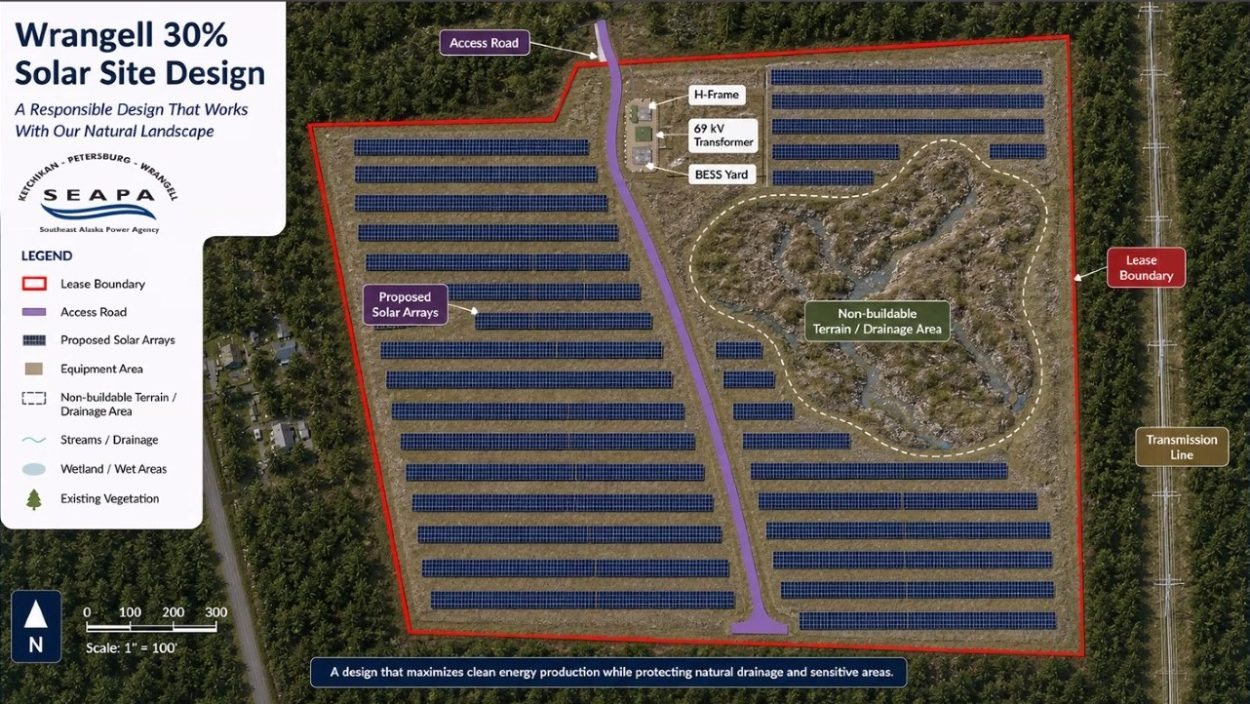
A 44-acre solar power farm in Wrangell is starting up. The local borough assembly approved the project at a meeting on May 12. The island town is partnering with a nonprofit that supplies it and two other Southeast communities with hydroelectricity.
Listen to the story:
Wrangell uses diesel-generated power every June for at least a week while the local hydropower system gets maintenance. This year, that short stint is expected to cost Wrangell about a quarter of a million dollars.
But a new solar farm could offset this cost in the future.
“This is huge for our economic development potential,” said Wrangell’s borough manager, Mason Villarma, speaking to the assembly.
The solar farm will start with a capacity of 1.5 megawatts, with plans to expand to 5 megawatts of battery power. That’s enough to keep Wrangell’s lights on during short outages.
“If there’s a bird strike on the lines, or a tree on the lines, or something like that, that fluctuation will just cause the whole grid to go down,” Villarma said.
Wrangell, like Petersburg and Ketchikan, runs mostly on hydroelectricity generated by two lakes. The system is operated by the public nonprofit Southeast Alaska Power Agency or SEAPA. The communities share a power grid of overland lines and submarine cables.
Villarma said solar energy will complement this hydropower system during periods of high demand, such as in the winter. He said it will also prepare Wrangell for economic development on the horizon, such as a new shipyard that’s expected to be the largest in the region.
“The diesel prices skyrocketed, given the war in Iran and geopolitical events, and as such, this project could fully run the town,” he said. “We wouldn’t have to burn any diesel.”
SEAPA will build and operate the solar farm, leasing the land from the City and Borough of Wrangell for $1 a year. In exchange, Wrangell will get priority for the generated power. The location is on previously logged land about six miles south of town on the upland side of Zimovia Highway. The borough acquired the land from the Alaska Mental Health Trust Authority in March through a land swap.
The power agency has been seeking additional capacity in recent years as residential use has increased. Residents moved from diesel heating to electric heat pumps. There are also more electronics in most homes. The power agency also plans to expand its hydroelectric capacity in the next few years by adding a third turbine at Tyee Lake and a new substation near Ketchikan.
But they also wanted to pursue solar after studying other alternative energy options. They looked at wind, but in Southeast it’s either not blowing or blowing too strongly. Tidal technology is too new, and there are too many unknowns for permitting. And geothermal exploration was too costly.
SEAPA’s CEO, Robert Siedman, hosted a town hall in Wrangell this month about the solar farm.
“It’s built to support local renewable energy goals,” he said. “We want to stay renewable and stay off diesel.”
He said people often question solar power in Southeast – after all, it is a rainforest. But he said solar still works. It just works less, say, than a sunny state like Arizona. He said Wrangell’s farm will run at about 10-20% of capacity over the course of a year.
“Has anybody been out on their boat, and it’s been cloudy, and you come home with a sunburn?” he asked. “I think we all have. Solar works in the clouds. It works.”
It’s not clear exactly when the solar project will be complete.
The first phase is expected to cost $6 million. SEAPA hopes to use outside funding for most of it, including to save half through investment tax credits. That funding requires the project to be fast-tracked. Some of the construction must be completed by July 4 due to limitations in the One Big Beautiful Bill passed by Congress. The bill killed the 30% federal tax credit for residential solar projects.
The borough’s land lease term is 25 years.