The Alaska Department of Fish and Game put out a call earlier this month, seeking volunteers to help monitor for the small but destructive invasive European green crabs moving into Southeast. The U.S. Forest Service has stepped up to help look at Anan Creek and elsewhere in the Wrangell area.
Forest Service staff set up traps last week at Anan, where the agency maintains a summer crew for the bear-viewing season.
The state agency provided half a dozen crab traps for the Forest Service Wrangell district.
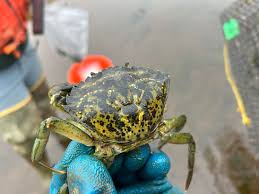
“We’re just trying to help with the monitoring effort,” said Anna Tollfeldt, a natural resource specialist with the Wrangell Ranger District. “The biggest thing is knowing how to identify them.”
“Despite their name, European green crabs are not always green — they can range from orange, yellow and red to brown or grey,” according to the National Marine Fisheries Service. “The most definitive way to identify them is by counting the five sharp spines behind each eye, and the three rounded bumps directly between the eyes.”
The crabs, which were first discovered in Alaska in 2022 at Annette Island, have spread northward and were discovered last October at a bay north of Cooney Cove on Etolin Island.
“The green crab is considered one of the most invasive species in the marine environment,” according to the federal fisheries service. “It has few predators, aggressively hunts and eats its prey, destroys seagrass and outcompetes local species for food and habitat.”
“It has been documented that green crab devour juvenile king crab as well as juvenile salmon,” the fisheries service says. “They also destroy eelgrass habitat that larval fish use to hide from predators and outcompete Dungeness crabs for food and habitat.”