Student scientists from the Wrangell High School Shakes Glacier monitoring team and University of Oregon graduate student Victoria Benson, last week, gave a two-part presentation on the nearby Shakes Glacier.
Together, their research showed how the glacier – located just up the Stikine River – has changed over time and the mechanisms impacting its behavior today.
Silje Morse, a high school junior, shares.
In Alaska, there are an estimated 100,000 glaciers, and despite this, there are roughly 27,000 recognized glacier bodies, which are the larger ones. Only about a third of glaciers in Alaska have actual names.
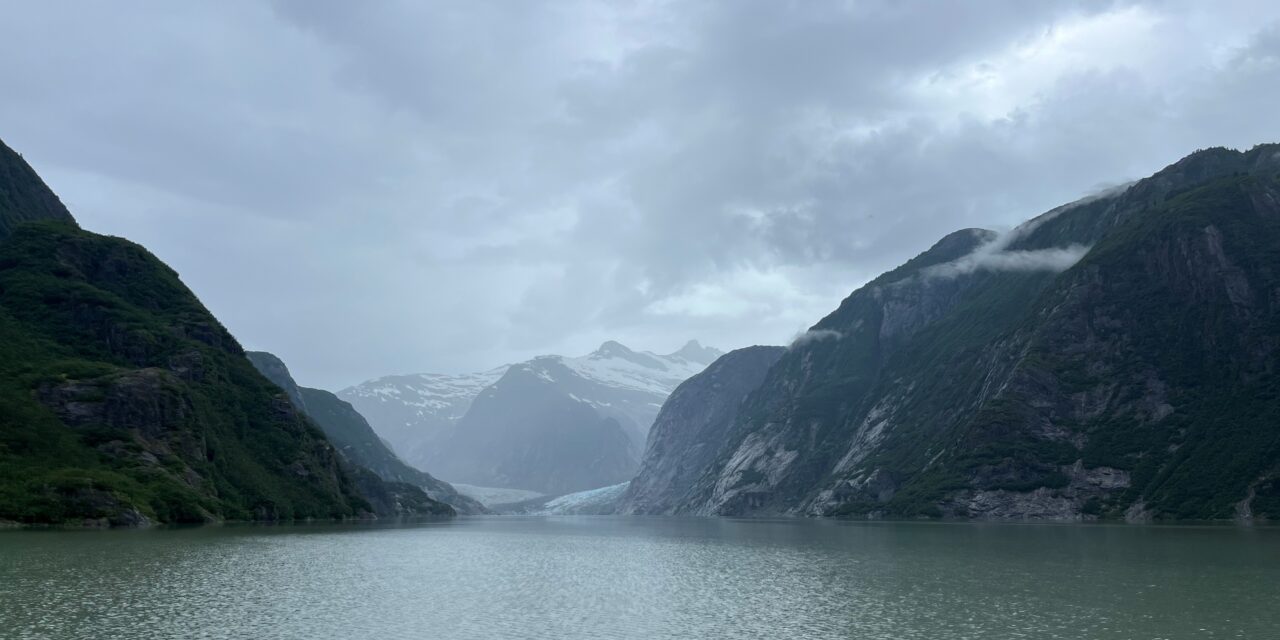
Shakes Glacier drains from the Stikine Icefield and terminates at Shakes Lake. Senior Andrei Bardin-Siekawitch says they’ve seen big changes.
The glacier has receded about 10,000 feet, or 1.9 miles, since 1999 through 2023. It has recessed 7,500 feet since 2011, when the Stikine River glacier survey started.
Graduate student Victoria Benson’s research focuses specifically on glaciers that terminate into a lake. She says the research shows that while marine glaciers are losing mass, lake-terminating glaciers have lost a lot more by comparison.
Her work compared the behavior of two Southeast Alaska glaciers – Shakes and Mendenhall, in Juneau.
They mapped the topography underneath the lakes to better understand what characteristics might be at play. Benson explains.
We can collect water depth by having basically a big fish finder or a sonar that can tell us how deep the water is.
They then measured the water temperature and how much sediment was suspended in the water column at different depths to build a temperature profile of the lake.
Benson says that the water at Mendenhall became cooler throughout the summer. This indicated that increased summer glacier melt was cooling the system.
But Shakes Lake showed the opposite behavior. The lake warmed through the season, as would be expected in a non-glacier lake. Benson says that doesn’t mean the glacier was not melting. She says the lake may be too big for glacier melt to dramatically change its temperature.
To address whether there is melt happening, they were able to map the front of the glacier using drones, which showed caves forming in the base of the glacier face. She says that, along with the mildly cooler temperatures near the face and increased sediment in the water, showed there was likely glacier melt coming out through cracks at the base of the glacier.